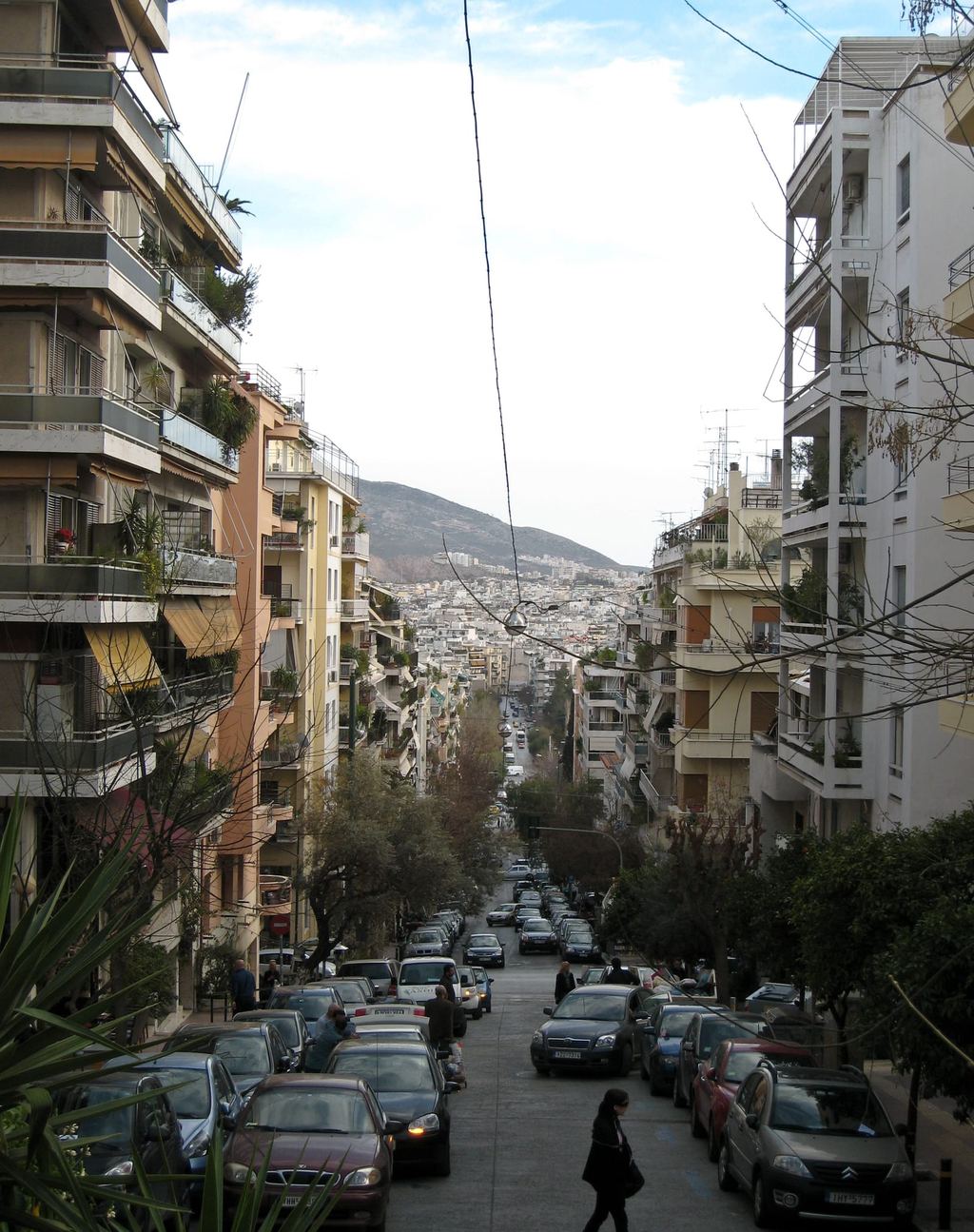
A street in the Kolonaki district, Athens.
The short answer: stay in Plaka if you want to walk out of the door and be at the Acropolis in five minutes, and you accept crowds and tourist prices. Stay in Koukaki if you want almost the same closeness to the Acropolis in a calmer, lived-in neighbourhood; in our price sample it matched Plaka in November and cost less in May. Stay in Kolonaki if you would trade a 21 minute walk to the Acropolis for quieter streets, a direct metro line to the airport (Plaka has one too), Lycabettus Hill and the museum quarter on your doorstep.
I have lived in Kolonaki for more than a decade and I host guests here, so read this knowing where I sleep. That is also why I have tried hard to be fair: a guest who should have booked in Koukaki is not a happy guest. Below you will find the three areas side by side with measured distances, then each one in turn with its real downsides, and finally a plain "choose this if" list.
The three areas side by side
All walking distances are OpenStreetMap pedestrian routes, measured on 10 October 2026 from a central point in each area: Kolonaki Square, Plaka's Filomousou Square on Kydathineon Street, and the pedestrian end of Drakou Street in Koukaki. Minutes assume an easy 4.8 km/h. The Acropolis has two entrances: the main one at the west end, and a second on the south slope on Dionysiou Areopagitou, near the Acropolis Museum.
| At a glance | Kolonaki | Plaka | Koukaki |
|---|---|---|---|
| Walk to the Acropolis | 1.7 km to the south slope entrance (about 21 min); 2.1 km to the main entrance (about 26 min) | 430 m to the south slope entrance (about 5 min); 930 m to the main entrance (about 12 min) | 740 m to the south slope entrance (about 9 min); 810 m to the main entrance (about 10 min) |
| Nearest metro | Syntagma, lines 2 and 3 (650 m); Evangelismos, line 3 (730 m) | Akropoli, line 2 (640 m); Syntagma (700 m); Monastiraki, lines 1 and 3 (830 m) | Syngrou-Fix and Akropoli, both line 2 (100 to 650 m) |
| Airport by metro | Direct on line 3 from Evangelismos or Syntagma | Direct on line 3 from Syntagma or Monastiraki | Change at Syntagma |
| Hills and steps | Gentle climb from Syntagma, steep above the square | Stepped lanes near Anafiotika, otherwise flat | Mostly flat |
| Noise | Quiet upper streets; metro worksite on the square by day | Busy lanes until late in season | Residential and quiet; traffic on Syngrou Avenue at the edge |
| Price level (our read) | High for rooms and restaurants | High for rooms; tourist pricing on the main lanes | Level with Plaka in November, cheaper in May, in our sample |
| Food | Neighbourhood tavernas, fish, pies, a Friday street market | Tavernas built for visitors, a few good ones off the main lanes | Easy, local cafés and tavernas |
| Nights out | Bars on Haritos and Skoufa, quieter wine bars higher up | Tavernas with music, rooftop bars with Acropolis views | Small neighbourhood bars |
| After dark | Lived-in, residential, people out late | Busy until late in season, emptier in winter | Residential and lived-in |
| Suits | Couples, repeat visitors, longer stays, work trips | A first trip of two or three days | Value seekers, families, food lovers |
The noise and nightlife rows, and the Kolonaki and Plaka price levels, are my own judgement from living here, not a survey; the Koukaki price comparison comes from the Google Hotels sample in our where to stay in Athens guide. Everything else is measured or sourced in the sections below.
Plaka: the Acropolis at the end of the street
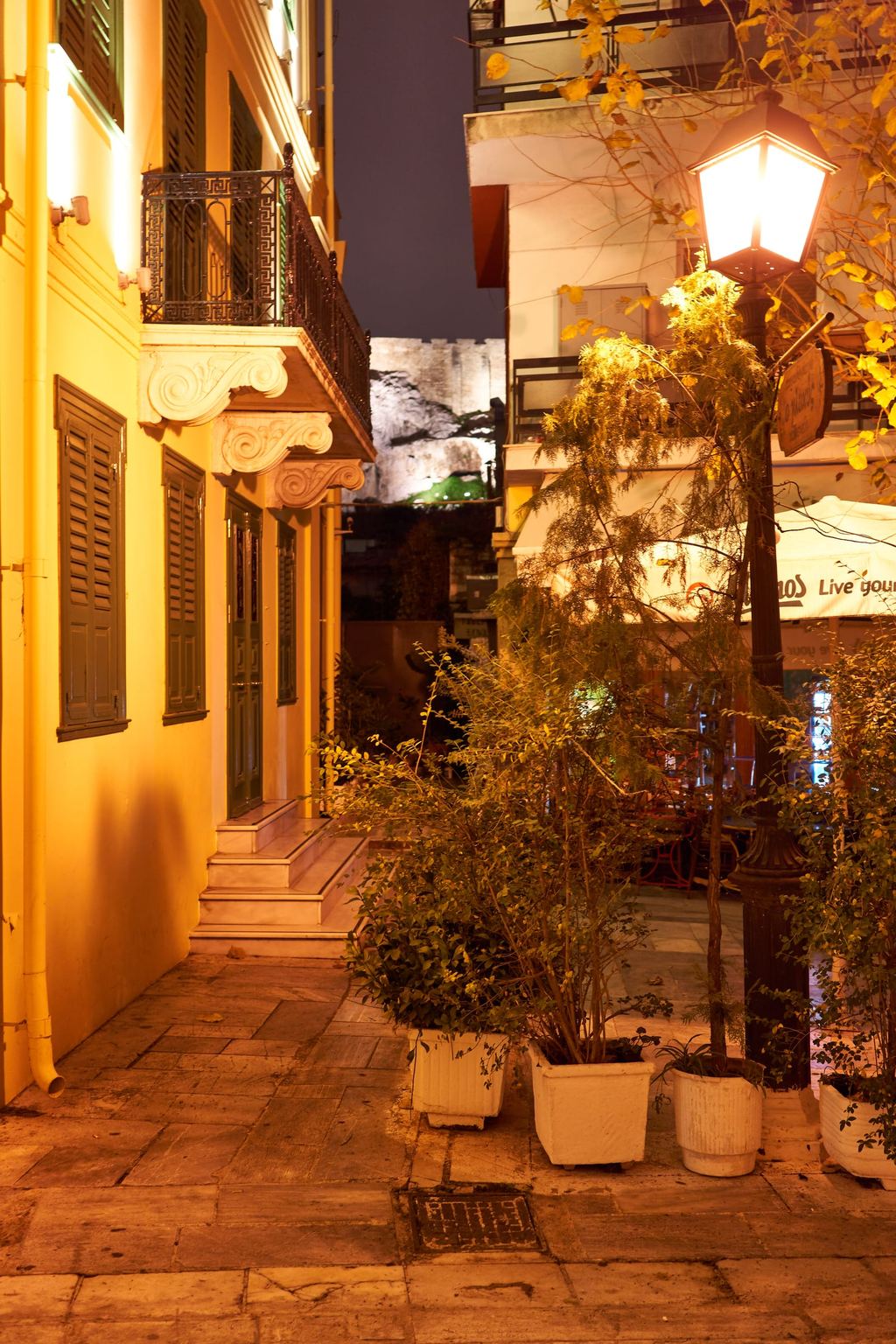
Geronta Street in Plaka with the Acropolis beyond, Athens.
Plaka is the old town under the north and east slopes of the Acropolis, and it is genuinely beautiful. Above it, the whitewashed lanes of Anafiotika look like a Cycladic village dropped into the city. From Filomousou Square you are five minutes from the south slope entrance, which no other area here can match.
What you give up
Plaka is the most visited neighbourhood in Athens, and it shows. The tavernas on Adrianou and the main stretch of Kydathineon are priced for visitors, and Athenians rarely eat there. The lanes around Anafiotika are stepped and steep, which matters with a suitcase, a buggy or tired knees. In summer the main streets stay busy and loud until late; in winter some of it feels shuttered. You are close to the sights and a little removed from everyday life.
Choose Plaka if
- it is your first trip, you have two or three days, and the Acropolis is the point;
- you want to walk everywhere and never think about the metro;
- atmosphere matters more to you than price or quiet.
Koukaki: the sensible all-rounder
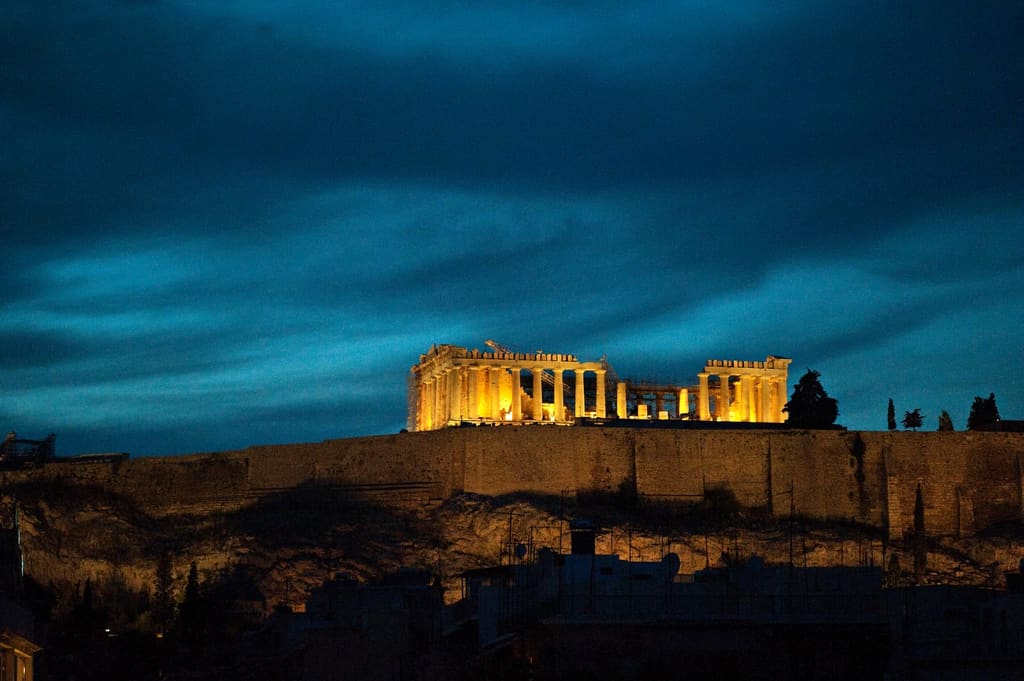
The Acropolis seen from leafy Koukaki, Athens.
Koukaki sits just south of the Acropolis, between Filopappou Hill and Syngrou Avenue. From the pedestrian end of Drakou Street it is about ten minutes on foot to either Acropolis entrance, and the Acropolis Museum is 770 metres away. It is a real residential neighbourhood with easy cafés and tavernas on Drakou and Olympiou, and Filopappou Hill gives you a free, pine-covered walk with one of the best views of the Parthenon in the city.
What you give up
Koukaki is on metro line 2 only, so the airport means a change at Syntagma, and Syntagma itself is 1.6 km away on foot. It has none of Plaka's postcard looks and none of Kolonaki's museums and shops. Its eastern edge runs along Syngrou Avenue, a busy road, so a flat on that side can be noisy. For most independent travellers that is a fair price for what you save.
Is Koukaki safe?
People ask this a lot. In my experience, yes: it is residential, lived-in and has people on the streets in the evening. The realistic risk anywhere in central Athens is pickpocketing in crowds, on the metro and around Monastiraki, rather than anything more serious. My guide to staying safe in Athens goes street by street.
Choose Koukaki if
- you want to be close to the Acropolis without paying Plaka prices;
- you would rather eat where Athenians eat;
- you are travelling with children or anyone who struggles with steps, since it is mostly flat.
Kolonaki: calm, central, and a little uphill
Kolonaki is the neighbourhood on the southern slopes of Lycabettus Hill, the highest point in central Athens. Kolonaki Square is 650 metres from Syntagma and 730 metres from Evangelismos station, about eight to nine minutes on foot either way. The Benaki Museum, the Museum of Cycladic Art and the Byzantine and Christian Museum are all within a short walk, and the lower station of the Lycabettus funicular is 600 metres from the square. My guide to Lycabettus and the funicular starts from there.
What you get
Quieter streets, especially higher up towards Dexameni Square (see our map of the neighbourhood). Food that is cooked for the people who live here: Filippou on Xenokratous for a classic taverna, Barbounaki on Haritos for fish, Kalamaki Kolonaki on Ploutarchou for skewers, and a street market on Xenokratous on Fridays. In summer, Cine Dexameni shows films under the stars. My notes on eating like a local in Kolonaki, favourite cafés and where to drink go further. Line 3 runs straight to the airport from Evangelismos and Syntagma, so arrival and departure are as simple as from Plaka.
What you give up
I would rather you heard these from me than found them on arrival.
- The Acropolis is a real walk. 21 minutes to the south slope entrance, or one stop on line 2 from Syntagma. It is not a five minute stroll.
- It is uphill. Syntagma sits at roughly 95 metres above sea level, Kolonaki Square at about 130, Dexameni at about 150 and the funicular station at about 195 (SRTM elevation data, checked 10 October 2026). The walk from Syntagma to the square is gentle; above the square some streets are steep or stepped. I wrote a whole guide to the lower and upper parts of Kolonaki because of it.
- The square is a building site. Kolonaki Square is the worksite for a station on the new metro line 4, about 35 metres underground (Skai). Hellenic Metro aims to complete the whole line by 2032, after an earlier June 2029 date slipped (Powergame, April 2026). Expect hoardings and daytime works, and know that the life of the neighbourhood has drifted to the streets around it.
- It costs more. Rooms and restaurants are priced like the smart part of town it is.
- August is quiet. Many neighbourhood restaurants close for part of August, while Plaka's tourist-facing places stay open. Lycabettus can also close on red-alert fire days: it shut to all activity on 28 June 2025. My guide to the best time to visit Athens covers the season.
Choose Kolonaki if
- you have been to Athens before, or you are staying a week or longer (see a month in Kolonaki);
- you want quiet evenings and food cooked for locals;
- you want a direct metro ride to the airport;
- you have an appointment at Evangelismos hospital (see staying near Athens hospitals).
Getting between them, and to the airport
The three areas are close. Plaka to Koukaki is about 1.1 km, roughly 14 minutes on foot past the Acropolis Museum. Kolonaki to Plaka is 1.3 km, about 17 minutes, downhill on the way there. Kolonaki to Koukaki is 2.3 km, about 28 minutes, so most people take the metro or a taxi. My guide to getting around Athens covers tickets and lines, and STASY posts metro service changes.
For rides, these apps let you pay by card in the app:
| App | What it books | iPhone | Android |
|---|---|---|---|
| Uber | Licensed taxis (in Greece) | iPhone | Android |
| Bolt | A ride | iPhone | Android |
| FREENOW by Lyft | Licensed taxis | iPhone | Android |
| Lemon | Licensed taxis | iPhone | Android |
To phone a radio taxi: Parthenon +30 210 532 3300 or Kosmos +30 210 411 8300 (both can be called from a foreign phone). Kosmos also has the short number 18300, from a Greek mobile.
From Athens airport to any of the three areas a taxi charges a flat fare of €50 by day and €65 between 00:00 and 05:00 (ΦΕΚ Β 5674/2026). Taxis must accept cards by law since April 2024, but ask before you get in.
So which one is right for you?
- First trip, two or three days, Acropolis first: Plaka.
- First or second trip, on a budget, travelling with children, or you love eating out: Koukaki.
- A return visit, a longer stay, a work trip, or you simply want quiet nights and the easy airport run: Kolonaki.
For the whole city, including Syntagma, Monastiraki and Psyrri, read my guide to where to stay in Athens, and for the neighbourhood itself, my complete guide to Kolonaki.
Staying with us in Kolonaki
If Kolonaki fits, we host two owner-managed apartments here, one on each side of the slope. The one-bedroom on Deinokratous is 78 m² on a quiet upper street, 100 metres from the Lycabettus funicular, for couples and solo travellers. The two-bedroom on Ipsilantou is 65 m² in the flat lower band, 130 metres from Evangelismos metro, and sleeps up to six. You can compare both apartments or book direct, with no platform fees.
Photos: Sharon Mollerus / Wikimedia Commons / CC BY 2.0; George E. Koronaios / Wikimedia Commons / CC BY-SA 4.0; Ggia / Wikimedia Commons / CC BY-SA 3.0.