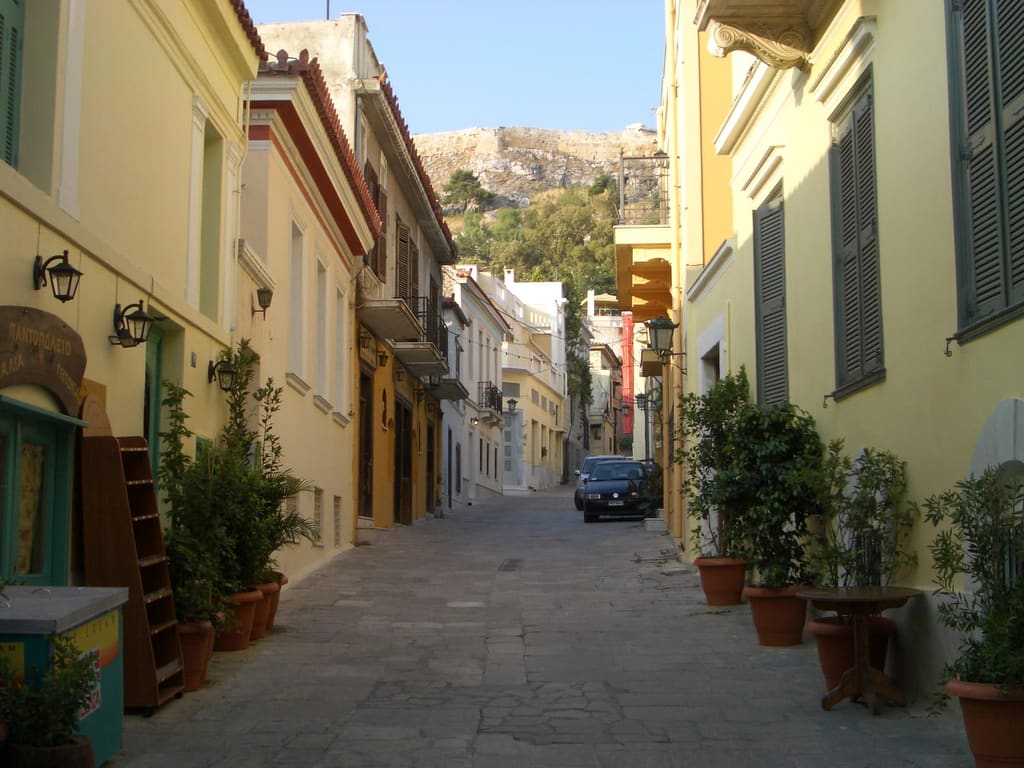
A calm Plaka street by day, central Athens.
The short answer: Yes. Athens is a safe city for visitors by the standards of any European capital, and violent crime against tourists is uncommon. Canada rates Greece at its lowest level, "take normal security precautions", and the UK's advice centres on theft, drink spiking and demonstrations rather than violence (FCDO, Greece: safety and security). The real, everyday risk is pickpocketing on crowded metro trains and in the busiest tourist streets. Keep your phone and wallet secure, take a taxi rather than walk unfamiliar streets around Omonia late at night, and save one number: 112, the free European emergency line.
I have lived in Kolonaki for more than ten years and host guests in two apartments here. I walk these streets every day and often late at night, and I am the person guests message when something goes wrong, which, honestly, is rare. This guide follows the order you will need it: the one risk worth planning around, the scams to ignore, how the city changes area by area after dark, the practical things that catch out more visitors than crime does, and finally what to do and whom to call if something does go wrong.
The real risk: pickpockets
The most common thing that goes wrong for visitors in Athens is a phone or wallet lifted in a crowd. The UK government says thefts of passports, wallets and handbags are common on the metro and in crowded tourist places, particularly in central Athens (FCDO). Canada adds that organised groups use distraction techniques and names the metro and the trains to and from the airport (Travel.gc.ca).
Where it happens
| Where | Why it is a target | What to do |
|---|---|---|
| Metro Line 1 (green), Piraeus to Monastiraki and Omonia | Packed with tourists from the port and the flea market, doors open onto crushes | Keep your phone in a front pocket or a zipped bag in front of you |
| Line 3 (blue) airport trains | Visitors with luggage, distracted by maps and bags | Valuables on your body, never in an outer backpack pocket |
| Monastiraki Square, the flea market, the busiest streets of Plaka | Dense crowds, attention on the sights | Crossbody bag, zip closed, worn in front |
| Busy interchanges: Syntagma, Omonia, Monastiraki | Pushing at the doors as trains fill and empty | Be most alert in the moment you board or get off |
| Larissa railway station | Named by Canada for theft from travellers | Keep luggage in sight and in contact |
Line 1 is the one I warn guests about by name. In my experience it is the line where the crowd is densest and the most tourists are carrying everything at once, especially between Piraeus and Omonia. The Line 3 trains from the airport stop at Syntagma and at Evangelismos, the station beside our two-bedroom apartment, and our guide to getting around Athens covers that ride in detail.
How to carry your things
- A crossbody bag with a zip, worn in front, beats a shoulder bag or an open tote every time.
- Never keep a phone in a back pocket, or on a café table near the pavement.
- Split your cards and cash; keep a photo of your passport's photo page on your phone and leave the passport itself in the apartment safe if you have one.
- On a crowded train, stand with your back to a wall or a pole rather than in the doorway.
None of this is Athens-specific paranoia. It is the same sense you would use in Rome, Barcelona or Paris, and it is most of what you need.
Scams and small annoyances
A few tired tricks circulate in the tourist core. None is dangerous; all are easy to avoid once you know them.
- The friendly bar invitation. A stranger strikes up a conversation near the nightlife streets and suggests a bar he knows, which then presents a wildly inflated bill. Choose your own bars, and check the bill.
- The helper at the ticket machine. Someone offers to help you buy a metro ticket. The machines have an English option; buy your own ticket.
- Card skimming at cash machines. Canada warns that card and ATM fraud occurs. Use machines inside banks or in busy public places and cover the keypad (Travel.gc.ca).
- Drink spiking. The UK advice asks travellers to watch each other's drinks and not let a friend walk home alone (FCDO). This applies in any city's nightlife, and Athens is no exception.
- The taxi without a meter running. Rare now that most rides are booked through apps, but if you hail one in the street, make sure the meter is on, and confirm the published airport flat fare before you set off (see below).
Athens at night, area by area
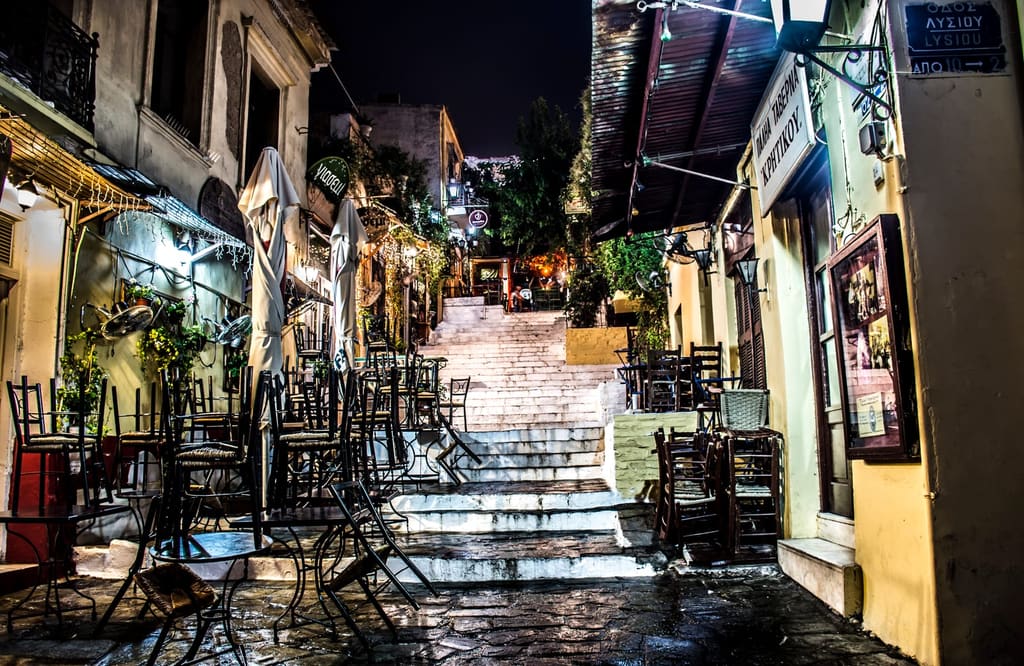
The quiet Anafiotika quarter beneath the Acropolis, Athens.
By day the whole historic centre is comfortable and busy. After dark the picture is more nuanced, as it is in every capital. This is how I would describe it to a friend arriving for the first time, from where I live to where I would take a taxi.
| Area | Late in the evening | My advice |
|---|---|---|
| Kolonaki | Residential and upscale, quiet streets, people out until late around the bars | I walk it at any hour |
| Plaka, Anafiotika, Koukaki | Calm, lit, plenty of people at dinner until late | Fine on foot |
| Syntagma and the main avenues | Busy until late, the hub for taxis and the metro | Fine; the square is also where demonstrations gather |
| Monastiraki, Psyrri | Lively, crowded, the main nightlife streets | Fine, but watch your pockets in the crowd |
| Omonia and the streets just north and west of it | Quieter, rougher at the edges after midnight | Take a taxi rather than walk unfamiliar side streets |
| Exarchia | A lively student and bar area, with occasional clashes on protest anniversaries | Fine for a drink; avoid it on 17 November and 6 December |
None of these is a no-go zone by day. Omonia is simply a busy, ordinary part of the city in daylight. The difference is the hour, not the place.
Getting home late
The simplest rule I give guests is this: after midnight, if the walk home crosses streets you do not know, take a taxi. On most nights the metro stops shortly after midnight; on Saturdays Lines 2 and 3 have run through the night since September 2025 (Alfavita, 12 September 2025). Check the STASY timetable before you rely on it. Taxis in Athens are yellow and licensed, and the easiest way to get one is through a ride app that takes your card:
| App | What it books | iPhone | Android |
|---|---|---|---|
| Uber | Licensed taxis (in Greece) | iPhone | Android |
| Bolt | A ride | iPhone | Android |
| FREENOW by Lyft | Licensed taxis | iPhone | Android |
| Lemon | Licensed taxis | iPhone | Android |
To phone for one instead: Parthenon +30 210 532 3300 or Kosmos +30 210 411 8300 (both can be called from a foreign phone). Kosmos also has the short number 18300, from a Greek mobile. Since 2024 taxis have been required by law to accept cards, but ask before you get in. Between the airport and the city centre taxis charge a flat fare per car: €50 by day and €65 at night (00:00 to 05:00), the rates in force since 18 September 2026 (To Vima, 16 September 2026).
Solo and women travellers
Athens is a reasonable, manageable city for solo travel, including for women, and many solo guests have stayed with us and moved around the city comfortably. The same rules apply as anywhere: stay on lit, busier streets at night, trust your instinct about a bar or a stranger, and choose an app taxi over an empty late walk through an area you do not know. The UK advice suggests saving your accommodation's location in your maps app and using pre-arranged transport or a taxi app late at night (FCDO). A calm residential base helps too, because coming home to a quiet, well-kept street at the end of the night is easier than returning to a loud, crowded corner.
Protests, strikes, heat and other practical risks
Demonstrations
Demonstrations are part of Athenian life and usually peaceful, but you should keep clear of them. They gather around Syntagma Square, Omonia Square, the Polytechnic on Patision Avenue and Exarchia (Travel.gc.ca). The UK advice notes that police often use tear gas and flags three dates when political marches are likely: 1 May, 17 November and 6 December (FCDO). On those days some central metro stations may close for hours, so plan your sightseeing around them.
Strikes
Public transport strikes happen a few times a year and are announced in advance. They mostly mean a missing metro or a slower journey, not a safety problem. Check the STASY announcements the day before an airport run, and keep a taxi app on your phone as the backup.
Summer heat and fire days
In July and August the midday sun is a real safety factor and catches out more visitors than crime does. Carry water, use shade, and do the Acropolis and the long walks early in the morning or in the evening. On days of extreme fire risk the city can close Lycabettus and other green hills; the Civil Protection fire risk map shows the next day's level, and our Lycabettus guide explains what that means for a sunset visit. Our guide to the best time to visit Athens covers the cooler months.
Tap water
Tap water in central Athens is generally considered safe to drink, and I drink it at home. Some guests still prefer bottled water for the taste, which is a matter of preference rather than safety.
If something goes wrong
Emergency numbers
| Number | What it is for |
|---|---|
| 112 | European emergency number: police, ambulance, fire. Free from any phone |
| 100 | Police |
| 166 | Ambulance (EKAB, the national emergency medical service) |
| 199 | Fire service |
| 1571 | Tourist Police, 24 hours, anywhere in Greece |
112 is free in Greece and across the EU (General Secretariat for Civil Protection), and it works alongside the older national numbers 100, 166 and 199 (Civil Protection, 2020). The Tourist Police line, 1571, is listed in Canada's official travel advice (Travel.gc.ca). The Tourist Police are part of the Hellenic Police.
Pharmacies and hospitals
For anything minor, start at a pharmacy, the green cross you will see on almost every block in Kolonaki. Greek pharmacists give real advice and many speak English. At night and on Sundays, use the Pharmaceutical Association of Attica’s on-duty list to find an open pharmacy.
Hospitals in Athens take emergencies on a rotating duty roster, so the nearest hospital is not always the one on call. In a real emergency call 166 or 112 and the ambulance will take you to the right one. For information on which hospitals and pharmacies are on duty, the Ministry of Health runs the free 24-hour line 1566 (Alfavita, 30 July 2026). Evangelismos, one of the largest hospitals in Greece, is in lower Kolonaki beside Evangelismos metro, and our guide to staying near Athens hospitals covers its rules and contacts.
If you are robbed
- Block your cards and phone first, from your bank's and carrier's apps.
- For insurance you will need a police report. Call the Tourist Police on 1571 and they will tell you which station to go to.
- For a lost passport, contact your embassy in Athens. The photo of your passport's photo page on your phone makes this much faster.
- Tell your host. If you are staying with us, message me and I will help with the phone calls in Greek.
Why Kolonaki is the calm base
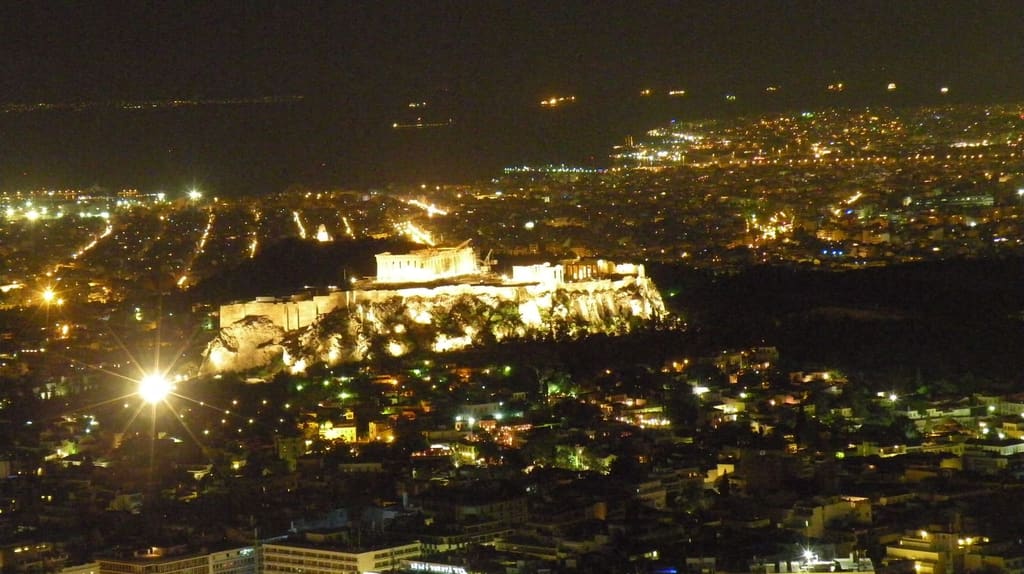
The floodlit Acropolis of Athens at night.
I will say it plainly and own the bias: I host here, so of course I think it is one of the calmest bases in the city. But the reason I live in Kolonaki is the same reason it suits cautious travellers. It is central: Kolonaki Square is about an eight-minute walk uphill from Syntagma metro, while the upper streets are steeper. It is a quiet residential neighbourhood at the foot of Lycabettus Hill rather than a tourist thoroughfare. Kolonaki Square itself is currently a fenced construction site for the new Metro Line 4, whose Kolonaki station Hellenic Metro targets for September 2032, but the streets around it are as calm as ever. You can read more about the neighbourhood, its history and its map on our Kolonaki page.
For families I suggest the two-bedroom apartment beside Evangelismos metro, on the flat lower side of the neighbourhood. Couples and solo travellers tend to like the one-bedroom near the Lycabettus funicular, on the quieter upper streets.
Where to go next
- Choosing a neighbourhood: where to stay in Athens sets out the trade-offs across the city, and Kolonaki vs Plaka vs Koukaki is the honest side-by-side.
- The neighbourhood itself: our local's guide to Kolonaki and where to stay in Kolonaki.
- Getting around: the metro, the airport and taxis in getting around Athens.
- Planning the days: our two to three day Athens itinerary, and for an evening out close to home, drinks in Kolonaki.
- Staying longer: a month in Kolonaki.
When your dates are fixed, you can see both apartments or book direct. We answer in English and Greek throughout your stay, and I am always happy to tell you which streets I would walk and which I would take a taxi through.
Last updated 11 October 2026. Photos: Public domain (JFKennedy); Hiotisd / Wikimedia Commons / CC BY-SA 4.0; Tednat / Wikimedia Commons / CC BY-SA 4.0.