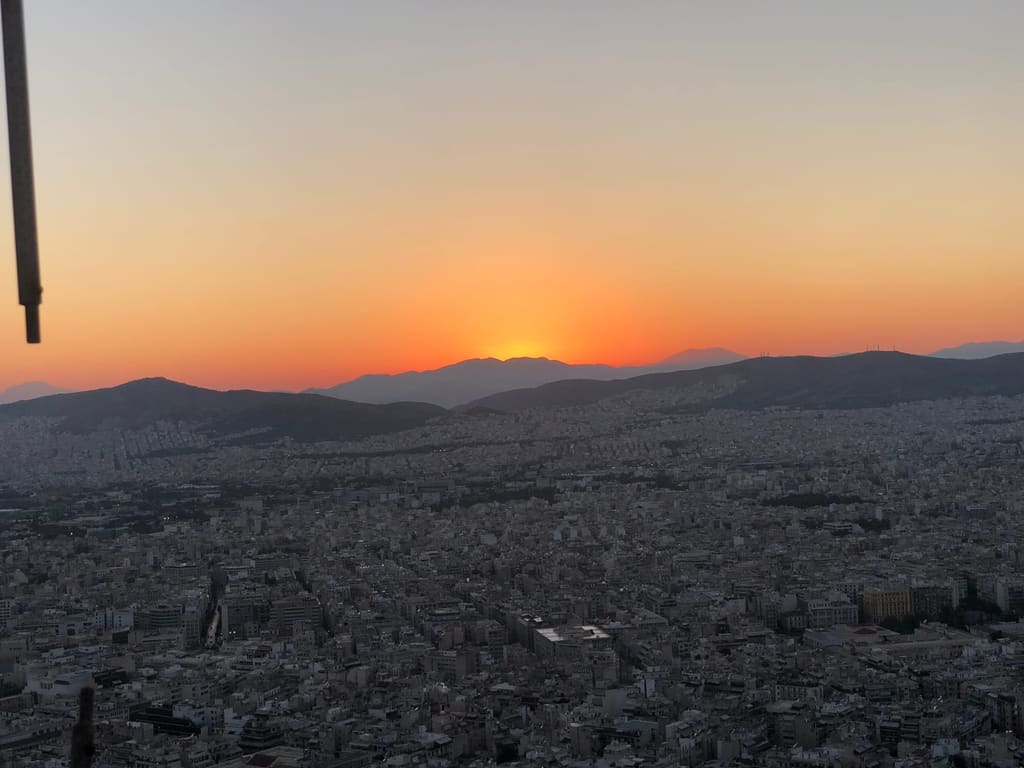
Sunset panorama over Athens from the summit of Mount Lycabettus.
The short answer: Lycabettus is the highest hill in central Athens, 277 metres, and it rises straight out of Kolonaki. You can walk up from the end of Aristippou Street in 20 to 40 minutes, or ride the funicular from the same spot in a few minutes (€10 one way, €13 return, service from 09:00 to 02:30 according to the operator, checked 10 October 2026). Get to the summit terrace by the Chapel of Agios Georgios half an hour before sunset and stay for the blue hour. On extreme fire-risk days in summer the City of Athens closes the whole hill, so check the news on the morning you plan to go.
I have lived in Kolonaki for more than ten years and host guests in two apartments here, one of them about 100 metres from the funicular. Lycabettus is the first thing I tell every guest to do, usually on their first evening, because ten minutes on the summit explains the geography of Athens better than any map. This guide follows the order you will need it: plan the visit, get up the hill, make the most of the top, then come down and carry on with your evening in the neighbourhood.
Planning your visit
What time is sunset on Lycabettus?
Sunset is the reason most people climb, and in Athens it moves by almost four hours across the year once daylight saving is counted. The table gives approximate times for the middle of each month. For the exact time on your date, use timeanddate's Athens sun calculator.
| Month (15th) | Sunset | Light gone (end of civil twilight) |
|---|---|---|
| January | 17:27 | 17:56 |
| February | 18:02 | 18:29 |
| March | 18:31 | 18:57 |
| April | 19:59 | 20:27 |
| May | 20:27 | 20:56 |
| June | 20:48 | 21:20 |
| July | 20:47 | 21:18 |
| August | 20:20 | 20:48 |
| September | 19:34 | 20:01 |
| October | 18:48 | 19:15 |
| November | 17:14 | 17:42 |
| December | 17:06 | 17:36 |
Local time, my own calculation from the NOAA solar position formula, cross-checked against timeanddate.com (21 June: 20:50; 1 December: 17:05). Times shift by a minute or two with the year.
Plan to be on the terrace 30 to 45 minutes before sunset. From May to September the railing fills up, and the best spots go first. In winter you will often have it almost to yourself.
If you would rather avoid the crowd altogether, late morning gives you the same view with far fewer people, and the light over the Acropolis is cleaner for photos than the summer haze of late afternoon.
Summer fire-risk closures
Lycabettus is a pine-covered hill in the middle of a city that has lived through bad fire seasons, and the City of Athens now closes it outright on dangerous days. On 1 August 2026, with Attica at fire-risk category 5, the top of the scale (a state of alert), and strong winds forecast, the city shut Lycabettus and Finopoulou Hill from midnight, to pedestrians and vehicles alike, until further notice (SKAI, 31 July 2026). It did the same at the end of June 2025, closing Lycabettus from midnight on 28 June (Proto Thema, 28 June 2025).
What this means for you between June and September:
- Check the next day's fire risk forecast map from Civil Protection the evening before. If Attica shows category 4 (very high) or 5 (state of alert), assume the hill may close.
- Have a backup sunset. The terraces around Dexameni Square in upper Kolonaki look west across the city and are a five minute walk below the funicular.
- Never light anything on the hill, including cigarettes, at any time of year. If you see a fire, call 112 or the fire service on 199.
What to bring
- Shoes with grip if you are walking. The path is part dirt, part stone steps worn smooth by feet, and they get slippery.
- Water from May to October. There is nothing to buy on the path itself, only at the summit.
- A layer for the evening. The summit is exposed and the wind picks up once the sun goes down, even in summer.
- A card and some cash for the funicular. The operator's site does not say which payments the ticket office takes, so carry both.
- Plan for the steps. Whichever way you arrive, the last stretch to the chapel is a stairway, so the very top is not step-free.
Getting up the hill
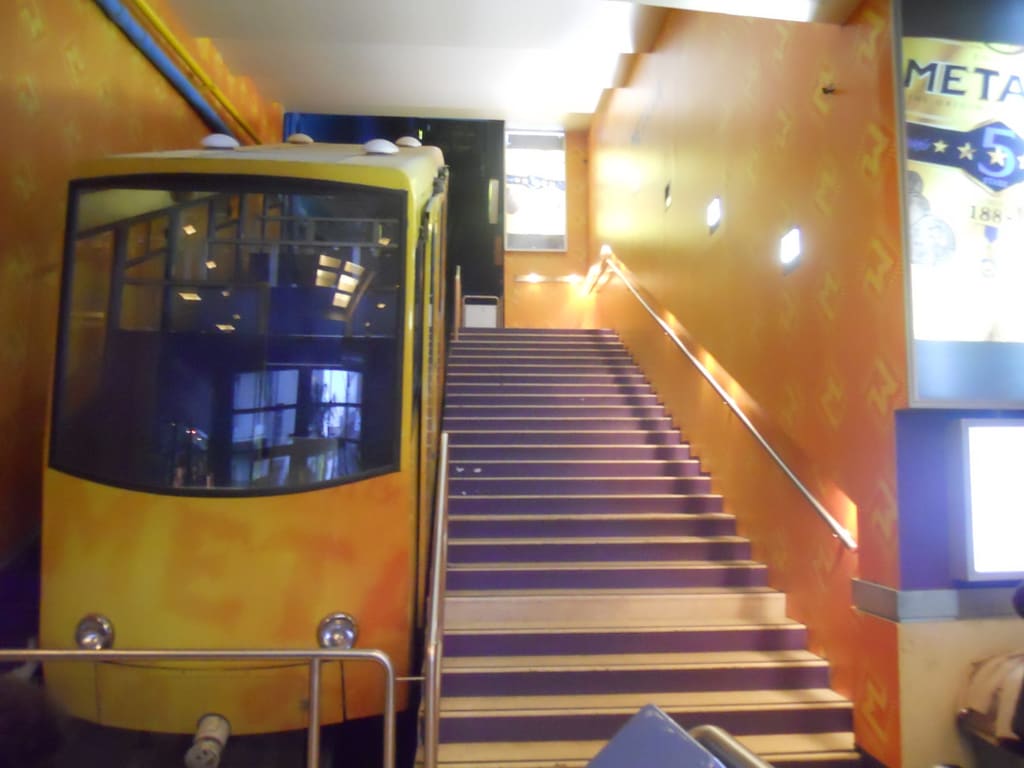
The Lycabettus funicular car ascending the hill, Athens.
All the routes start from the same corner of Kolonaki: the top of the neighbourhood where Ploutarchou meets Aristippou. Getting there is the first climb.
| From | Distance to the funicular station | Allow |
|---|---|---|
| Dexameni Square | about 300 m | 5 minutes |
| Kolonaki Square | about 600 m | 10 minutes, uphill |
| Evangelismos metro (line 3) | about 650 m | 10 to 12 minutes, uphill |
| Syntagma metro (lines 2 and 3) | about 1 km | 20 minutes, uphill most of the way |
Distances from OpenStreetMap pedestrian routing, checked 10 October 2026. The times allow for the slope; at a flat-ground pace of 4.8 km/h, the pace used in our other guides, they would be 4, 7, 8 and 13 minutes.
The simplest approach is to walk up Ploutarchou until it turns into stairs, and keep climbing until you reach the funicular station on Aristippou. If you are coming from Evangelismos metro, our getting around Athens guide covers the metro and tickets.
On foot: the path through the pines
The footpath starts beside the funicular's lower station and climbs through the pine woods on the Kolonaki side of the hill, partly on dirt switchbacks and partly on stone stairs, passing the small church of Agioi Isidoroi, which is set into the rock. Higher up it joins the stairway that leads to the summit.
It is a real climb but a steady one. Most people take 20 to 40 minutes from the station, depending on pace and on how often they stop to look back at the view, which you will. The walk gives you viewpoints the funicular cannot, because the funicular runs entirely in a tunnel.
In July and August, go up in the early morning or start no earlier than about two hours before sunset. Midday on this slope, in full sun, is miserable.
The funicular
The Lycabettus funicular is a cable-hauled railway that runs inside the rock, from Aristippou Street in Kolonaki to just below the summit. There is no view on the way up, but the ride takes only a few minutes, it is cool in summer and easy on the knees.
| Lower station | Aristippou 1, Kolonaki |
| Hours | Service from 09:00 to 02:30, every day |
| Frequency | Every 30 minutes, every 10 minutes at busy times |
| One way | €10 per person |
| Return | €13 per person |
| Cars | Two, up to 34 passengers each |
Source: the operator's access page on the Orizontes Lycabettus site, checked 10 October 2026. Hours and fares change, so look again before you go. The operator lists adult fares only; ask at the ticket office about children.
My usual advice is to walk up and ride down. You earn the view, and after dark the funicular saves your knees on the steps.
By taxi or car
A road circles the hill and climbs to the car park by the Lycabettus Theatre, a little below the summit. From there, according to the operator, a footpath takes you to the top in 5 to 10 minutes. On theatre nights in the 2026 season, only taxis, drivers with a disability badge and people over 60 could drive up to that car park (Ta Nea, 23 July 2026); check the city's announcement for the next season.
Taxis in Athens are yellow and licensed, and the easiest way to get one is through a ride app that takes your card:
| App | What it books | iPhone | Android |
|---|---|---|---|
| Uber | Licensed taxis (in Greece) | iPhone | Android |
| Bolt | A ride | iPhone | Android |
| FREENOW by Lyft | Licensed taxis | iPhone | Android |
| Lemon | Licensed taxis | iPhone | Android |
To phone for one instead: Parthenon +30 210 532 3300 or Kosmos +30 210 411 8300 (both can be called from a foreign phone). Kosmos also has the short number 18300, from a Greek mobile. Taxis are required by law to accept cards, but ask before you get in.
At the summit
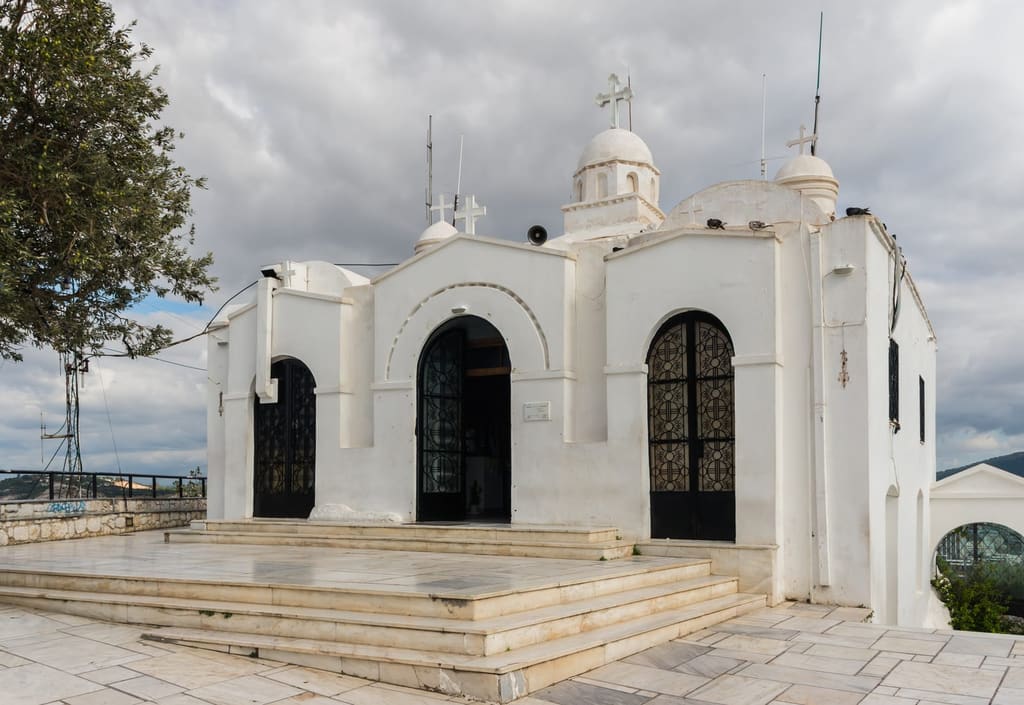
The Chapel of St George on the summit of Lycabettus, Athens.
The Chapel of Agios Georgios
The small white chapel on the summit is Agios Georgios (Saint George), a 19th-century church, and the terrace around it is the viewing platform (Orizontes Lycabettus). It is a working church rather than a monument, so be quiet near the door, and cover your shoulders if you step inside.
The view, and where the sun actually goes down
From the railing the whole basin of Athens is below you: the Acropolis in the middle distance, Piraeus and the Saronic Gulf beyond it, and on a clear day Aegina on the horizon. The mountains of Hymettus, Penteli and Parnitha close the city in behind you.
Most guides tell you the sun sets "behind the Acropolis". That is only true in winter. Seen from the chapel, the Parthenon lies at a bearing of about 232 degrees, south-west. By my calculation of the sun's position, in December and January the sun sets at around 240 degrees, just to the right of the Acropolis and over Piraeus. In June and July it sets at about 300 degrees, far to the right, over Mount Aigaleo. So in summer, stand on the western side of the terrace and look over the city towards the hills; in winter, look straight down the line of the Acropolis towards the sea.
Whatever the season, wait for the half hour after the sun has gone. The city lights come on, the floodlit Acropolis stands out against a darkening sky, and the crowd thins as people head for the funicular.
Eating and drinking at the top
The summit has two venues run by the same group as the funicular: the all-day Skybar café, and Orizontes, a fine-dining restaurant with the same view (Orizontes Lycabettus). Its May 2026 menu lists mains from €29 to €55, so you are paying for the view as much as the food. For a sunset drink the café is enough. For dinner, I would rather walk down and eat in Kolonaki, which is what most of my guests end up doing.
The Lycabettus Theatre
On the far side of the hill, just below the summit, is the Lycabettus Theatre, an open-air amphitheatre designed by the architect Takis Zenetos. It was closed for 15 years and reopened on 15 September 2023 after a renovation by the City of Athens that kept his original design (iefimerida, 16 August 2023).
The programme is now run by Technopolis, the City of Athens' cultural organisation, with concerts and plays from late spring to early autumn. In 2026 the autumn programme ran from 30 August to 5 October (City of Athens). The City of Athens and Technopolis announce each new season's dates, so check their announcements for the next programme. If your dates line up with a show, it is a memorable way to spend an evening on the hill.
How people got to a show in 2026 (the arrangements may change from season to season):
- On foot, the hill was open to pedestrians on show days.
- Free city shuttle from Sarantapichou Street, opposite number 3, where the road up the hill begins. On the 2026 programme it ran in loops from 19:00 to 21:30 (times vary by event) and brought people back down afterwards, with priority for older passengers, pregnant women and people with limited mobility.
- By car, only the groups listed above could drive to the car park. Motorbikes could park there.
Coming down and carrying on in Kolonaki
After dark
Once it is dark, take the funicular down rather than the footpath. The stairs are steep, and a twisted ankle is a poor end to the evening. The operator lists service until 02:30; check the time of the last departure at the ticket office before you rely on it.
The funicular drops you at the top of Kolonaki, and from there it is downhill all the way to dinner.
Pairing the hill with the neighbourhood
- Before you climb: coffee on the lanes below; we list the cafés we actually use in our favourite cafés in Kolonaki.
- After you come down: dinner within ten minutes' walk, from tavernas to seafood, in where to eat like a local in Kolonaki, and a drink on the quieter upper streets in drinks in Kolonaki.
- Fitting it into a short trip: the hill is the late-afternoon stop on day two of our two to three day Athens itinerary, and our best time to visit Athens guide covers the heat and the quieter months.
- The neighbourhood itself: start with our local's guide to Kolonaki, or read the story of how Kolonaki got its name, from Hadrian's reservoir at Dexameni to the funicular.
Staying at the foot of the hill
The easiest way to see Lycabettus at its best is to be able to decide on the evening itself, when the sky looks clear. From our one-bedroom apartment on Deinokratous the funicular's lower station is about 100 metres away, so you can decide on a sunset at the last minute. Our two-bedroom near Evangelismos is on the flat lower side of Kolonaki, beside the metro, about ten minutes' climb from the station.
If you are still choosing a neighbourhood, where to stay in Kolonaki explains which side of the hill suits which trip, and Kolonaki vs Plaka vs Koukaki sets out the honest comparison. When your dates are fixed, you can see both apartments or book direct, and I will tell you which evening of your stay looks best for the hill.
Last updated 10 October 2026. Photos: Nina1009 / Wikimedia Commons / CC BY-SA 4.0; Erik Drost / Wikimedia Commons / CC BY 2.0; Public domain (Jebulon).